
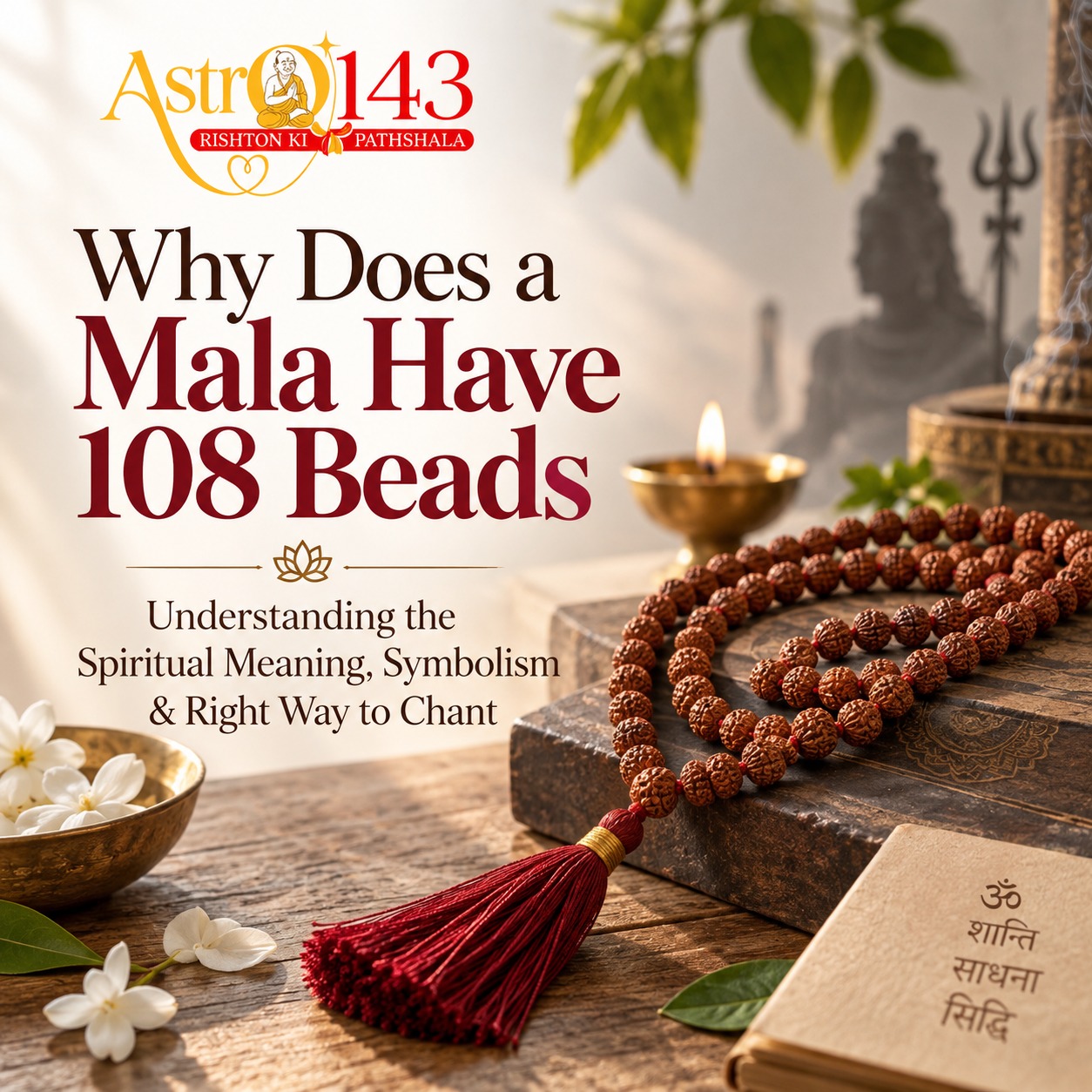
Why Does a Mala Have 108 Beads? Understanding the Spiritual Meaning, Symbolism & Right Way to Chant
When you look at a traditional mala, one detail immediately stands out. It usually has 108 beads arranged together in a continuous string.
But why exactly 108?
Why not 100, 50 or 110?
For people who use a mala for meditation, prayer or mantra chanting, the number 108 is more than just a way of counting. It has a long standing place in Indian spiritual traditions and is often connected with ideas of completeness, discipline, repetition and focused practice.
At the same time, there is not just one universally accepted explanation for the number 108. Different spiritual traditions give different symbolic interpretations to it.
So, understanding why a mala has 108 beads is really about understanding both its spiritual symbolism and its practical purpose.
Let's explore what 108 means, what the Guru bead represents and how you can use a mala correctly during mantra chanting.
What Is a Mala?
A mala is a string of beads traditionally used for mantra chanting, prayer, meditation and spiritual practice.
Instead of counting every repetition mentally, a person can move one bead after each mantra. This makes the mala a simple physical tool for keeping track of repetitions while maintaining attention on the practice.
A traditional 108 bead mala generally consists of:
- 108 counting beads
- One larger or differently designed Guru bead
- A string connecting the beads
- Sometimes a tassel or additional decorative element
The Guru bead is generally used as a reference point rather than being counted as one of the 108 repetition beads.
If you are looking for a mala specifically for spiritual practice, you can explore the Rudraksha Mala collection available through Astro143.

Why Does a Mala Have 108 Beads?
The simple answer is that 108 provides a traditional and complete cycle for mantra repetition.
However, the significance goes deeper.
The number 108 has been associated with spiritual practices across several Indian traditions. It is often treated as a sacred number and appears in different forms of prayer, meditation and ritual practice.
There are several traditional interpretations of why 108 is important.
108 as a Traditional Sacred Number
In Indian spiritual traditions, 108 is frequently treated as a number representing completeness or wholeness.
You may come across different explanations connecting 108 with concepts related to the universe, spiritual practice, sacred geometry, meditation and traditional cosmology.
These explanations are not all identical, and they do not necessarily come from one single source or tradition.
This is important because the meaning of 108 should not be reduced to one fixed formula.
Instead, 108 can be understood as a deeply established symbolic number that has become closely connected with spiritual practice.
108 as a Complete Chanting Cycle
One of the most practical reasons for using 108 beads is simple counting.
Suppose you have chosen a mantra for your daily practice.
Instead of repeatedly asking yourself, “How many times have I chanted?”, you can move from one bead to the next.
One bead represents one repetition.
When you reach the end of the 108 counting beads, you have completed one full round.
This gives your practice a clear beginning, middle and completion.
108 and Spiritual Discipline
Mantra practice is often less about doing something once and more about creating consistency.
Repeating a mantra for a fixed number of times can encourage discipline and focus.
The 108 bead mala therefore works as both a spiritual object and a practical counting tool.
It helps bring together:
Mantra + repetition + attention + discipline
What Is the Spiritual Meaning of 108?
The spiritual meaning of 108 has been interpreted in different ways across Indian traditions.
Rather than claiming one explanation is the only correct one, it is better to understand 108 as a number that has accumulated multiple layers of traditional symbolism.
Symbolism of 108 in Spiritual Traditions
The number 108 is often connected with ideas of:
- Completeness
- Spiritual discipline
- Repetition
- Meditation
- Devotional practice
- Cycles and wholeness
For many practitioners, completing 108 repetitions represents finishing one intentional cycle of practice.
The importance of 108 is therefore not necessarily about the beads themselves having a guaranteed effect. The value comes from the traditional meaning attached to the number and the discipline of the practice.
Why 108 Is Connected With Mantra Practice
Mantra chanting requires repetition.
When a mantra is repeated again and again, the mind has a simple point of focus.
A mala makes this process physical.
You chant the mantra.
You move one bead.
You chant again.
You move the next bead.
This rhythm continues until the full cycle is complete.
The mala therefore reduces the need to mentally count every repetition and allows greater attention to remain on the mantra.
If you want to explore different mantra practices, Astro143 also has a dedicated Mantra section with articles on different traditional mantras.
What Is the Guru Bead in a Mala?
The larger or distinct bead at the end of a mala is commonly called the Guru bead, Meru bead or Sumeru bead.
The Guru bead marks the point where one complete round of 108 repetitions ends.
It is generally not counted as one of the 108 mantra beads.
After completing one round, many traditional practices recommend stopping at the Guru bead and turning the mala around rather than crossing over it.
In simple terms:
108 beads = counting cycle
Guru bead = beginning and completion point
How Does a 108 Bead Mala Help With Chanting?
A mala can make mantra practice more structured.
Without a mala, you may have to count repetitions mentally. That can become distracting, especially during longer chanting sessions.
With a mala, your fingers provide a physical reminder of where you are in the cycle.
One mantra represents one bead, and 108 mantras represent one complete round.
The mala provides a traditional framework that can support concentration and regularity.
What Types of Malas Can Be Used for Chanting?
Rudraksha Mala
Rudraksha malas are among the most widely recognised malas in Hindu spiritual traditions.
They are commonly associated with Shiva and are traditionally used for prayer, meditation and mantra chanting.
Astro143 has different Rudraksha mala options, including 1 Mukhi Rudraksha Mala, 3 Mukhi Rudraksha Mala, 4 Mukhi Rudraksha Mala and 6 Mukhi Rudraksha Mala.
You can also learn more about the traditional background and uses of Rudraksha in the Rudraksha benefits guide.
Tulsi Mala
Tulsi mala is traditionally associated with devotional practices, particularly within Vaishnava traditions.
Tulsi is regarded as a sacred plant in Hindu traditions, and Tulsi malas are commonly used during prayer and mantra chanting.
Astro143 offers options such as the Tulsi Mala and Super Tulsi Mala.
Sphatik Mala
Sphatik, commonly associated with clear quartz, is another material used for malas.
For people interested in this traditional mala style, Astro143 has a Sphatik Mala.
Gemstone Mala
Gemstone malas are also used in spiritual and meditation practices.
Examples include Tiger Eye, Amethyst, Rose Quartz and Lapis Lazuli.
Astro143 offers a Tiger Eye Mala, Amethyst Mala, Rose Quartz Mala and Lapis Lazuli Mala.

How to Chant With a 108 Bead Mala Correctly
Step 1: Choose a Quiet Place
Choose a place where you can sit without frequent interruptions.
Step 2: Sit Comfortably
Sit in a comfortable position. You can sit on the floor, on a meditation cushion or on a chair.
Step 3: Hold the Mala Correctly
Traditions may differ regarding the exact hand and finger used. A commonly followed practice is to hold and move the beads using the thumb and middle finger while avoiding the index finger.
Step 4: Begin Near the Guru Bead
Start your chanting from the bead next to the Guru bead.
Step 5: Chant One Mantra Per Bead
Choose your mantra, chant it once and then move to the next bead.
Step 6: Complete One Full Round
Continue until you have moved through all 108 counting beads.
Step 7: Turn the Mala Instead of Crossing the Guru Bead
In many traditional practices, practitioners do not cross over the Guru bead. Instead, they turn the mala around and begin the next round in the opposite direction.
Can a Mala Have Fewer Than 108 Beads?
Yes. Although 108 is the traditional full cycle, malas with fewer beads are also commonly used.
For example, you may find malas with 27, 54 or 108 beads.
A 27 bead mala can represent one quarter of 108, while 54 represents half of 108.
Smaller malas can be practical when someone wants to complete a shorter chanting cycle or carry a smaller mala.
Common Mistakes While Using a Mala
1. Rushing Through the Mantra
The goal is not simply to finish 108 repetitions as quickly as possible. Try to keep your attention on the mantra.
2. Skipping Beads
Move one bead at a time so that the physical counting remains consistent.
3. Crossing the Guru Bead
If you follow the traditional method, stop when you reach the Guru bead and turn the mala around.
4. Treating the Mala Only as Jewellery
A mala can certainly be worn, but in traditional practice it also serves as a tool for prayer, chanting and meditation.
5. Focusing Only on the Number
The number 108 is important within the tradition, but simply completing 108 repetitions does not replace attention and sincerity.
Frequently Asked Questions
Why does a mala have 108 beads?
A traditional mala commonly has 108 counting beads because 108 is a sacred and symbolically significant number in several Indian spiritual traditions. It also provides a complete counting cycle for mantra repetition.
What is the spiritual meaning of 108?
The number 108 has multiple traditional interpretations and is often associated with completeness, spiritual discipline, meditation and devotional practice.
Is the Guru bead included in the 108 beads?
Usually, the Guru bead is treated separately from the 108 counting beads. It marks the completion point of one round.
How many times should I chant with a mala?
A traditional 108 bead mala allows one full round of 108 repetitions. You can complete one or more rounds depending on your practice and tradition.
Can I use a 27 bead mala instead of a 108 bead mala?
Yes. Smaller malas such as 27 or 54 beads can be used for shorter counting cycles.
Which mala is best for chanting?
There is no single mala that is universally best for every person or every mantra. Rudraksha, Tulsi, Sphatik and gemstone malas are all used in different spiritual practices.
Conclusion
So, why does a mala have 108 beads?
The answer combines tradition, symbolism and practical use.
The number 108 has a long association with Indian spiritual practices and is traditionally regarded as a meaningful and complete number. At the same time, 108 beads give the practitioner a clear structure for mantra repetition.
The Guru bead marks the completion of the cycle, while moving through each bead helps maintain a steady rhythm during chanting.
Whether you choose a Rudraksha mala, Tulsi mala, Sphatik mala or gemstone mala, the most important part of the practice is not simply reaching the 108th bead.
It is the attention, consistency and intention you bring to the practice.
A mala gives you a simple physical structure. Your practice gives that structure meaning.



.png)