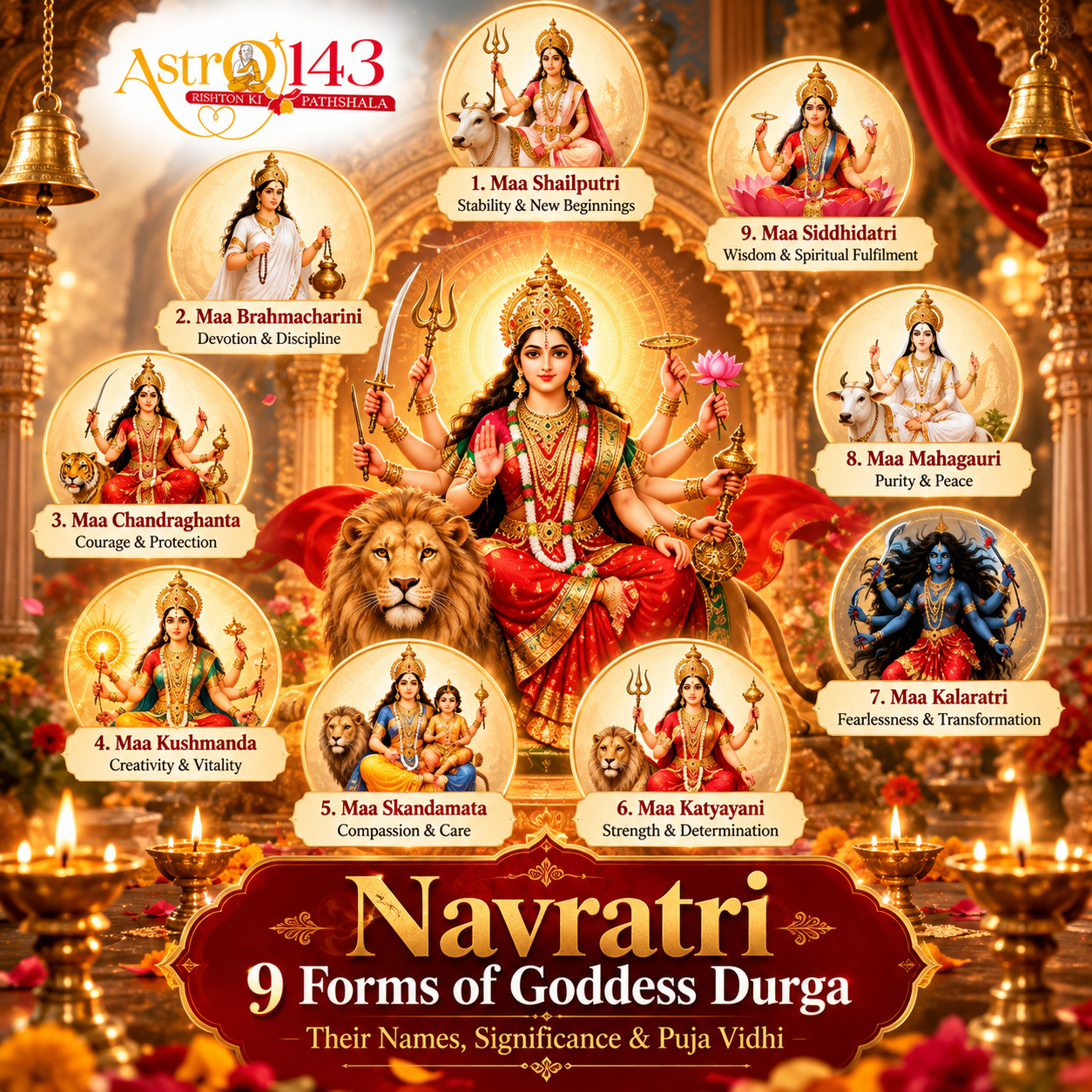
Navratri: 9 Forms of Goddess Durga, Their Names, Significance & Puja Vidhi
Navratri is one of the most cherished Hindu festivals, celebrated with devotion, prayer, fasting and cultural traditions. The word Navratri comes from two Sanskrit words: Nava, meaning nine, and Ratri, meaning night. During these nine sacred days, devotees worship Goddess Durga and her nine divine forms, collectively known as Navdurga.
Each form represents qualities such as courage, devotion, wisdom, strength, compassion and spiritual fulfilment. In this guide, discover the nine forms of Goddess Durga, their significance and traditional worship practices.
What Is Navratri and Why Is It Celebrated?
Navratri is a Hindu festival dedicated to the Divine Feminine, often represented by Goddess Durga. Sharad Navratri is celebrated around September or October. In Hindu traditions, Goddess Durga represents divine power that protects righteousness and overcomes negative forces.
Devotees may observe fasts, recite prayers, light a diya, visit temples, perform aarti and participate in community celebrations. Customs vary by region, family tradition and the Navratri being celebrated.

What Are the 9 Forms of Goddess Durga?
Day 1: Maa Shailputri
Maa Shailputri is worshipped on the first day. Her name means daughter of the mountains. She is commonly depicted riding a bull and holding a trident and lotus. Her form represents strength, stability, purity and new beginnings.
Spiritual significance: Stability, determination and a firm foundation for spiritual growth.
Day 2: Maa Brahmacharini
Maa Brahmacharini represents devotion, penance, self-control and dedication. She is traditionally depicted holding a rosary and a kamandalu, or water pot. Her story reminds devotees of the patience and discipline required to follow a spiritual path.
Spiritual significance: Devotion, patience, self-control and determination.
Day 3: Maa Chandraghanta
Maa Chandraghanta is associated with the crescent-shaped bell on her forehead. Often depicted riding a tiger or lion, she represents courage, readiness and the ability to face difficulties with balance.
Spiritual significance: Courage, confidence, alertness and protection.
Day 4: Maa Kushmanda
Maa Kushmanda is associated in devotional traditions with cosmic creation and the light and energy of the universe. Her form represents creative power, vitality and optimism.
Spiritual significance: Creation, vitality, optimism and creative energy.
Day 5: Maa Skandamata
Maa Skandamata is the mother of Skanda, also known as Kartikeya. Commonly depicted holding her child, she represents maternal love, compassion, care and protection.
Spiritual significance: Motherhood, compassion, care and protection.
Day 6: Maa Katyayani
Maa Katyayani is revered as a powerful form of Goddess Durga. Commonly depicted riding a lion, she represents courage, determination and the strength to stand against injustice.
Spiritual significance: Bravery, confidence, righteous action and determination.
Day 7: Maa Kalaratri
Maa Kalaratri has a fierce appearance and is revered as a protective form of the Goddess. Her imagery symbolises the force needed to overcome darkness, fear and ignorance.
Spiritual significance: Fearlessness, protection, transformation and overcoming darkness.
Day 8: Maa Mahagauri
Maa Mahagauri is associated with radiance, purity, peace and compassion. She is often depicted wearing white and riding a bull. Many devotees perform special prayers or Kanya Puja on Ashtami according to their family tradition.
Spiritual significance: Peace, purity, compassion and renewal.
Day 9: Maa Siddhidatri
Maa Siddhidatri is associated with spiritual accomplishments, wisdom and divine grace. Worshipped on Navami, she marks the culmination of the nine-day journey of devotion.
Spiritual significance: Wisdom, spiritual fulfilment, grace and completeness.
What Is the Significance of the Nine Days of Navratri?
- Day 1: Stability and new beginnings.
- Day 2: Discipline and devotion.
- Day 3: Courage and confidence.
- Day 4: Creativity and vitality.
- Day 5: Compassion and care.
- Day 6: Determination and righteous action.
- Day 7: Fearlessness and transformation.
- Day 8: Peace and renewal.
- Day 9: Wisdom and spiritual fulfilment.
These are devotional interpretations. Different traditions may explain the symbolism in different ways.
How to Perform Navratri Puja at Home
- Clean and prepare a peaceful prayer area.
- Arrange a diya, flowers, water and customary offerings.
- Begin with a prayer and set a devotional intention.
- Worship the form of Goddess Durga associated with the day.
- Recite familiar prayers, a mantra or aarti according to your tradition.
- Observe fasting only in a way that is suitable for your health and circumstances.
- End with gratitude and share prasad where customary.
If you would like help arranging a traditional ceremony, explore online puja services through Astro143. Check available services and details before booking.
What Should Devotees Keep in Mind During Navratri?
- Respect your family's customs and regional traditions.
- Keep your prayer space clean and use lamps safely.
- Choose fasting practices suitable for your health.
- Make time for prayer, gratitude and self-reflection.
- Practise kindness and consider acts of service.
- Remember that devotion is not measured only by elaborate rituals or expensive offerings.

Frequently Asked Questions About Navratri
What are the nine forms of Goddess Durga?
The nine forms are Maa Shailputri, Maa Brahmacharini, Maa Chandraghanta, Maa Kushmanda, Maa Skandamata, Maa Katyayani, Maa Kalaratri, Maa Mahagauri and Maa Siddhidatri.
Which Goddess is worshipped on the first day of Navratri?
Maa Shailputri is worshipped on the first day and symbolises stability, strength and new beginnings.
Which Goddess is worshipped on Ashtami?
Maa Mahagauri is commonly worshipped on the eighth day. Some families also perform Kanya Puja according to their tradition.
Which Goddess is worshipped on Navami?
Maa Siddhidatri is worshipped on the ninth day and is associated with wisdom, spiritual fulfilment and divine grace.
Can I perform Navratri puja at home?
Yes. Many devotees worship at home with a clean prayer space, a diya, flowers and customary offerings. Follow your family tradition and choose safe, manageable practices.
Are Navratri colours the same everywhere?
No. Colour sequences vary by region, calendar and tradition. Follow the custom observed by your family.
Conclusion
Navratri celebrates the strength, compassion, courage and wisdom represented by Goddess Durga. The nine forms of Navdurga offer devotees a meaningful way to reflect on different qualities, from the stability of Maa Shailputri to the spiritual fulfilment associated with Maa Siddhidatri.
For those interested in arranging a traditional ceremony, explore Astro143's online puja services. Visit the Astro143 Astrology Blog for more spiritual and astrology-related reading.
May Maa Durga bless you and your family with strength, peace, wisdom and happiness. Jai Mata Di!



.png)